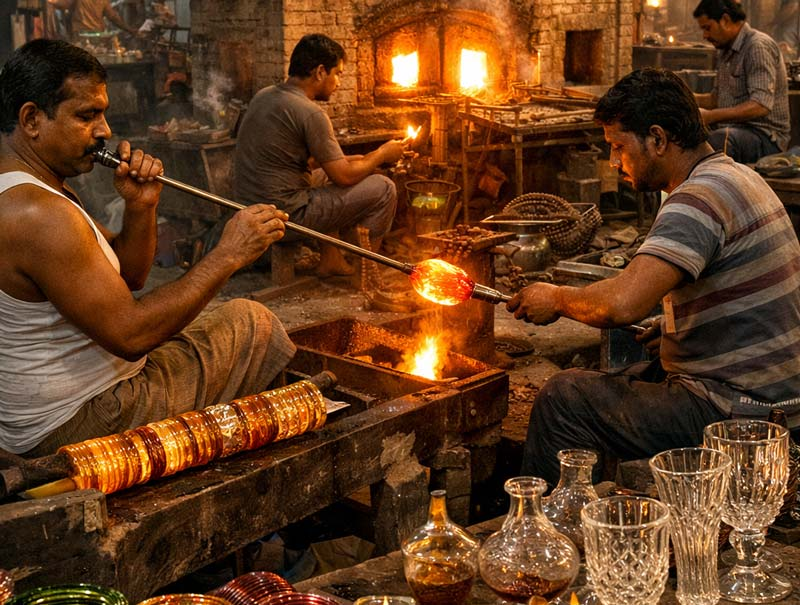
Firozabad, located in the state of Uttar Pradesh, is widely known as India’s Glass City. For centuries, this historic city has been the backbone of India’s glass manufacturing industry. The history of glass manufacturing in Firozabad is a remarkable story of craftsmanship, resilience, and generational knowledge that continues to shape India’s handmade and industrial glass production.
Ancient Origins of Glass Craft in Firozabad
The roots of glass manufacturing in Firozabad can be traced back more than 2,000 years. Archaeological findings suggest that early glassmaking techniques were practiced in this region during the Mughal era and even earlier. The availability of raw materials such as silica sand, soda ash, and fuel made Firozabad a natural center for glass production.
Over time, skilled artisans developed traditional methods of hand-blown glass, bead making, and bangles, laying the foundation for a craft that would define the city’s identity.
Growth During the Mughal Period
The Mughal era played a significant role in refining glass craftsmanship in Firozabad. Royal patronage encouraged the production of decorative glass items, ornaments, lamps, and bangles. Mughal artisans introduced intricate designs, vibrant colors, and advanced furnace techniques, which elevated Firozabad glass to an art form admired across northern India.
British Era and Industrial Expansion
The modern glass industry in Firozabad began to take shape during the British colonial period. In the late 19th and early 20th centuries, mechanized furnaces and improved production methods were introduced. Glass bangles, bottles, tableware, and utility items started being produced on a larger scale.
During this time, Firozabad emerged as a major supplier of glass products across India. Rail connectivity further boosted trade, enabling Firozabad glass manufacturers to reach national and international markets.
Post-Independence Transformation
After India’s independence, Firozabad experienced rapid industrial growth. Small family-run units expanded into organized manufacturing facilities. The city became especially famous for glass bangles, contributing nearly 70% of India’s bangle production.
Government support, export promotion councils, and skill development programs helped modernize production while preserving traditional techniques. Glass products from Firozabad began gaining recognition in global handicraft and décor markets.
Traditional Craftsmanship Meets Modern Technology
Today, the history of glass manufacturing in Firozabad reflects a unique balance between heritage craftsmanship and modern innovation. While hand-blown glass, lampworking, and mold-based techniques are still practiced, manufacturers have adopted advanced machinery, temperature-controlled furnaces, and quality-testing processes.
Firozabad now produces a wide range of products including decorative glassware, tableware, lighting products, laboratory glass, and architectural glass items.
Cultural and Economic Importance
Glass manufacturing is not just an industry in Firozabad—it is a way of life. Thousands of families depend on this craft for their livelihood. The industry plays a vital role in the city’s economy and preserves a cultural heritage passed down through generations.
Festivals, weddings, and religious ceremonies across India continue to rely on Firozabad-made glass bangles and decorative items, keeping the city deeply connected to Indian traditions.
Global Recognition of Firozabad Glass
In recent years, Firozabad glass products have gained international attention for their handcrafted quality, artistic value, and affordability. Exports to countries in Europe, the Middle East, and North America have strengthened the city’s position in the global glass market.
Efforts toward sustainable production and eco-friendly fuel alternatives are shaping the future of this historic industry.
The history of glass manufacturing in Firozabad is a testament to India’s rich artisan heritage and industrial evolution. From ancient handmade glass to modern manufacturing units, Firozabad continues to shine as the heart of India’s glass industry. As tradition and technology move forward together, the legacy of Firozabad glass remains timeless.